How to Get on Podcasts: A 20-Show Pitch Plan With AI
Summary
To get on podcasts, choose shows whose listeners match your audience, find an episode the host has not made yet, and pitch that episode in about 120 words. AI speeds up the research, the gap check and the tightening pass. The opening line and the relationship stay human, because hosts book episodes that fit their show, not people who describe themselves well.
How to get on podcasts comes down to three moves: pick shows whose listeners match yours, find an episode the host has not made yet, and pitch that episode in under 150 words. AI is useful for the research and the first draft, not for the pitch you actually send. Most guest pitches fail because they describe the guest, not the episode.
Apple Podcasts listed 482,930 shows that released an episode in the previous 90 days, as of June 2026. That is a big pool, and most of it is wrong for you. The work is narrowing it down to twenty shows worth a real pitch.
Hosts book episodes, not guests
A host with a weekly show has a gap to fill every seven days. Your name does not fill it. A specific topic with a clear angle does.
In my client work, the pitches that got replies all shared one trait: the subject line named an episode. "Why most AI product descriptions fail on mobile" gets opened. "Podcast guest inquiry" gets archived.
Write the episode title first. If you cannot write a title a listener would click, you do not have a pitch yet.
Three contexts where this holds, one where it does not. It holds for niche shows with 500 to 5,000 listeners per episode, for industry newsletters that also run a podcast, and for B2B shows with a recurring format. It does not hold for the top 50 shows in any category, where a publicist or a book launch decides who gets on.
That last point is worth accepting early. Aim your first ten pitches one tier below where your ego wants to go. Small shows book faster, record faster, and give you the clips and the practice that make the next pitch stronger.
Build a target list of 20 shows, not 200
Volume is the usual advice and it is usually wrong. Two hundred generic emails get you a spam folder. Twenty researched ones get you three or four conversations.
Start from audience, not from rankings. Look for the shows your own customers or readers already listen to, then add the shows those hosts have appeared on as guests. An audience research tool does this faster than guessing.

Keep a simple sheet with five columns: show, host, last episode date, guest policy, and the episode idea you would pitch. Drop any show that has not published in 90 days. Drop any show that never has guests.
Reviews and listener numbers are a weak filter. A show with 40 ratings and a loyal audience in your exact niche is a better target than a show with 4,000 ratings and a general audience. Read the last five episodes' titles and ask whether your topic would fit among them without looking forced.
Where AI helps in the research phase
This is where AI earns its place. Feeding a host's last ten episode descriptions to an assistant and asking for the topics they keep returning to takes two minutes. Doing it by hand takes an hour.
Here is the prompt I use, trimmed:
"Here are the titles and descriptions of the last 12 episodes of a podcast. List the 5 topics covered most often, the 3 topics never covered that sit next to them, and the guest profile that appears most. Do not invent episodes."
The last clause matters. Without it, general-purpose models will happily fabricate an episode that never aired, and a pitch that references a fake episode ends the conversation.
Long transcripts are a different job. If you want to check whether a host has already covered your angle, load several transcripts into a notebook-style tool and ask where your topic appears. Then you can write "you covered X in episode 41, but never Y" and mean it.
Always open the episode page yourself before you cite it. AI summaries of transcripts miss nuance, and the host will notice if you quote the wrong guest. The tool gets you to the right episode quickly. Your own ears confirm it.
The pitch itself: 120 words, one ask
Write it yourself, then let AI tighten it. The reverse order produces the smooth, empty email that every host recognises within a line.
A pitch that works has four parts:
Here is a stripped-down example for a copywriter pitching a marketing show. Subject: "Why your product pages lose buyers on mobile (episode idea)". Body: one line about the host's episode on conversion copy, the proposed title, two lines on client work with e-commerce brands, and a link to a one-page guest sheet. That is about 110 words, and every sentence does a job.
One sentence showing you listened to a specific episode
The episode title you propose, plus the gap it fills
Two lines of credibility that match the topic, no full biography
A single ask, with a link to a one-page guest sheet

Skip the attachment. Skip "I'd love to be a guest on your amazing show." Hosts read that line forty times a week.
The guest sheet deserves its own half hour. One page: a photo, a two-line bio, three episode topics with a sentence each, three questions you are good at answering, and where to find you. Ask an AI assistant to tighten the wording, then cut every adjective it adds. Hosts use this page to prepare, so a good one makes the recording itself easier.
The first line is where AI drafts go wrong. A generated opener like "I loved your recent episode on growth" is detectable at a glance. Write the first sentence by hand, from something you actually heard.
Warm the host up before you send
Hosts answer people they have seen before. A short, genuine reply to a post, a review of the show, or a question sent to the show's feedback address, a week before the pitch, changes how the email lands.
Respona's guide to podcast pitching suggests searching the show's site for your topic to find an episode gap. It is a simple check and it works. Search the show's own site for your keyword before you claim a gap exists.
Do not fake familiarity. If you did not listen, say you read the episode notes. Hosts forgive that. They do not forgive invented praise.
Timing matters less than people think. Mid-week mornings in the host's time zone are a reasonable default, but a relevant pitch on a Saturday beats an irrelevant one on a Tuesday. Check the show's recent episode dates: a host who has just launched a season is more open to new guest ideas than one wrapping up.
Follow up once, then move on
One follow-up, five to seven days later, two sentences, with the episode title repeated. After that, stop. A second follow-up turns a pitch into pressure.
Three mistakes show up again and again in the pitches that go nowhere. The first is pitching a show you have not opened. The second is sending the same email to ten hosts with the name swapped. The third is asking for a favour without offering anything: a promised share to your list, a clip for the host's socials, a topic that fits their audience.
Keep a log of replies. When a show says no, ask whether another episode idea fits. When a show says "not now," note a date three months out and set a reminder.
One practical tip: store your three best subject lines and your guest sheet link in a text snippet, so each pitch costs ten minutes of real research, not an hour of formatting.
Where AI helps again: drafting the follow-up variants and the polite no-reply responses so you are not rewriting the same three sentences all week. That is an afternoon saved over a month.
What AI cannot do is decide who to pitch next or whether an episode idea is any good. Those two calls decide whether the whole effort works, and they stay with you. In practice the tool shortens the grind, and the judgment stays manual.
Make the recording worth the pitch
Getting booked is half the job. A clean recording is what gets you rebooked and recommended to other hosts.
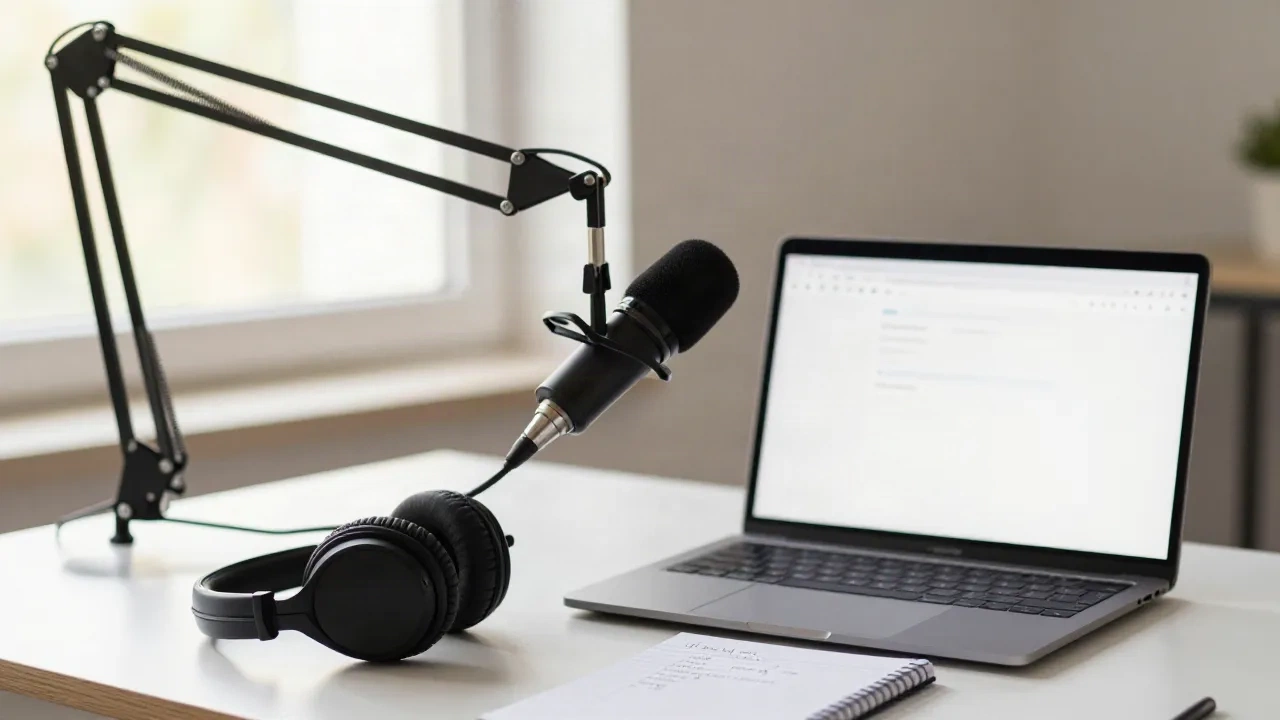
Use a wired headset or a USB microphone, record in a room with soft surfaces, and send your notes before the call. Afterward, ask for the raw audio if the host allows it, and clean your own clips for social posts.
Prepare three stories with a concrete number or a before and after in each. Hosts remember a client who cut a product page rewrite from three hours to forty minutes far longer than a list of principles. Keep each story under ninety seconds so the host can steer the conversation.

Transcripts also give you material. One 40-minute interview can become a short written recap, three quote cards and a newsletter section, which is the repurposing work that pays back the time spent on the pitch.
What to do this week
Pick one topic you can speak about better than most people. Build a list of twenty shows. Write three episode titles. Send five pitches, by hand, with a real first line.
Do not automate the sending. Use AI for the list, the gap check and the tightening pass, and keep the relationship part human. That split is what separates a booking from a deleted email.